Resources
Investigators carry far more matters than they can pursue. Cases are weighed against each other, and a modest, uninsured loss can struggle to compete for attention.
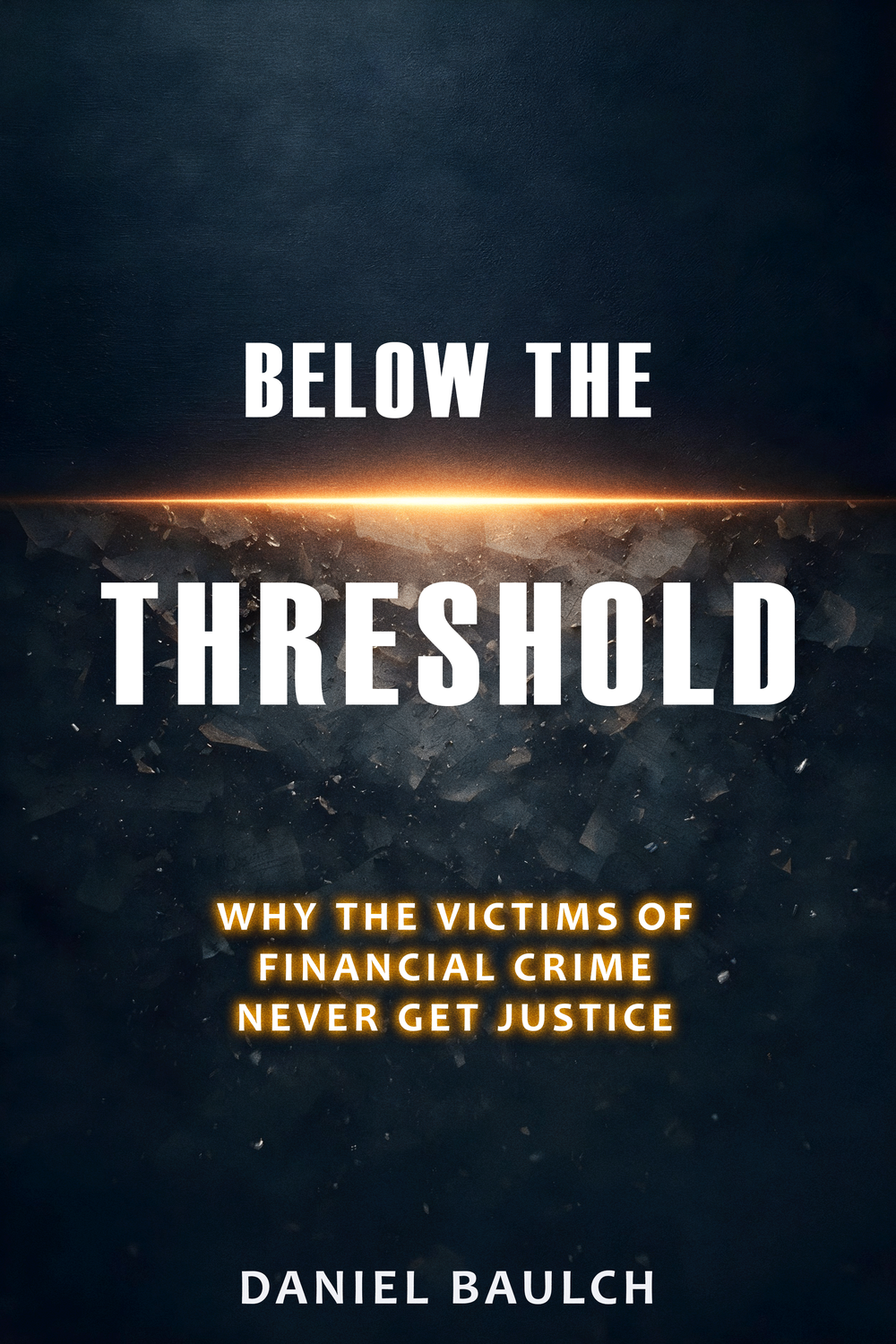
Below the Threshold — Why the Victims of Financial Crime Never Get Justice
Financial crime has industrialised faster than the justice system's capacity to respond. This book explains why so many reports stall, why ordinary people with modest, uninsured losses fall through the gap, and what real reform could look like.
There is no universal dollar threshold below which fraud is ignored, and no guarantee that any particular report will lead somewhere. What decides whether a matter moves are factors like these:
Investigators carry far more matters than they can pursue. Cases are weighed against each other, and a modest, uninsured loss can struggle to compete for attention.
The person who took the money may be in another state or another country. Deciding who is responsible — and whether they can act — takes time, and sometimes nobody can.
Accounts close, messages disappear and money moves in minutes. What survives, and whether it can be connected to a person, shapes what an investigation can achieve.
Even with a clear picture of what happened, an offender who cannot be identified, located or brought before a court limits what any agency can do.
An opening chapter sets out the problem. The book then moves from the boardroom to the kitchen table, and closes with a concluding chapter on what real reform could look like.
Part One · Chapters 2–6
Corporate deception and Ponzi schemes, the failures of Enron, Wirecard, Wells Fargo and Danske Bank, employee theft, ransomware and business email compromise.
Part Two · Chapters 7–10
Why cases struggle to become investigations, how institutions manage losses, the consequences for victims, and what reform and recovery can look like.
Daniel Baulch spent more than two decades in policing, professional standards, regulation and anti-corruption, including as a Victoria Police detective and as the inaugural Deputy Commissioner of Papua New Guinea's Independent Commission Against Corruption. He is the founder of Integrity Solve and the author of The Enterprise and Built to Be Examined.
More about DanielThere is no single, universal cut-off. Whether a matter progresses depends on several factors working together — the resources available, which agency has jurisdiction, what evidence survives and whether the offender can be reached. The book explains how those factors combine.
No. The book explains the structural barriers that cause many reports to stall. It cannot assess an individual matter, give legal advice or promise that money will be recovered. If you have been affected, keep reporting through the official channels available to you.
Anyone who has experienced fraud or a scam and wondered why their report went nowhere — and readers who want to understand how financial crime and the response to it really work.
Kindle, paperback and hardcover, through Amazon Australia. Each listing shows the current price and availability.
The reform articles grow out of the book's central argument. The book sets out the wider picture; the articles focus on specific changes worth examining.
Below the Threshold is available now on Amazon Australia.
The reform case