When integrity becomes your responsibility, bring more than good intentions.
Develop your understanding of investigations, evidence and the systems that help organisations act fairly under scrutiny.
Read the opening chapterFree — add your first name and email to open it.
Available now on Kindle and in paperback
You want to contribute more at work. To ask better questions. To recognise when a process is weak. To understand what should happen when a concern becomes an investigation.
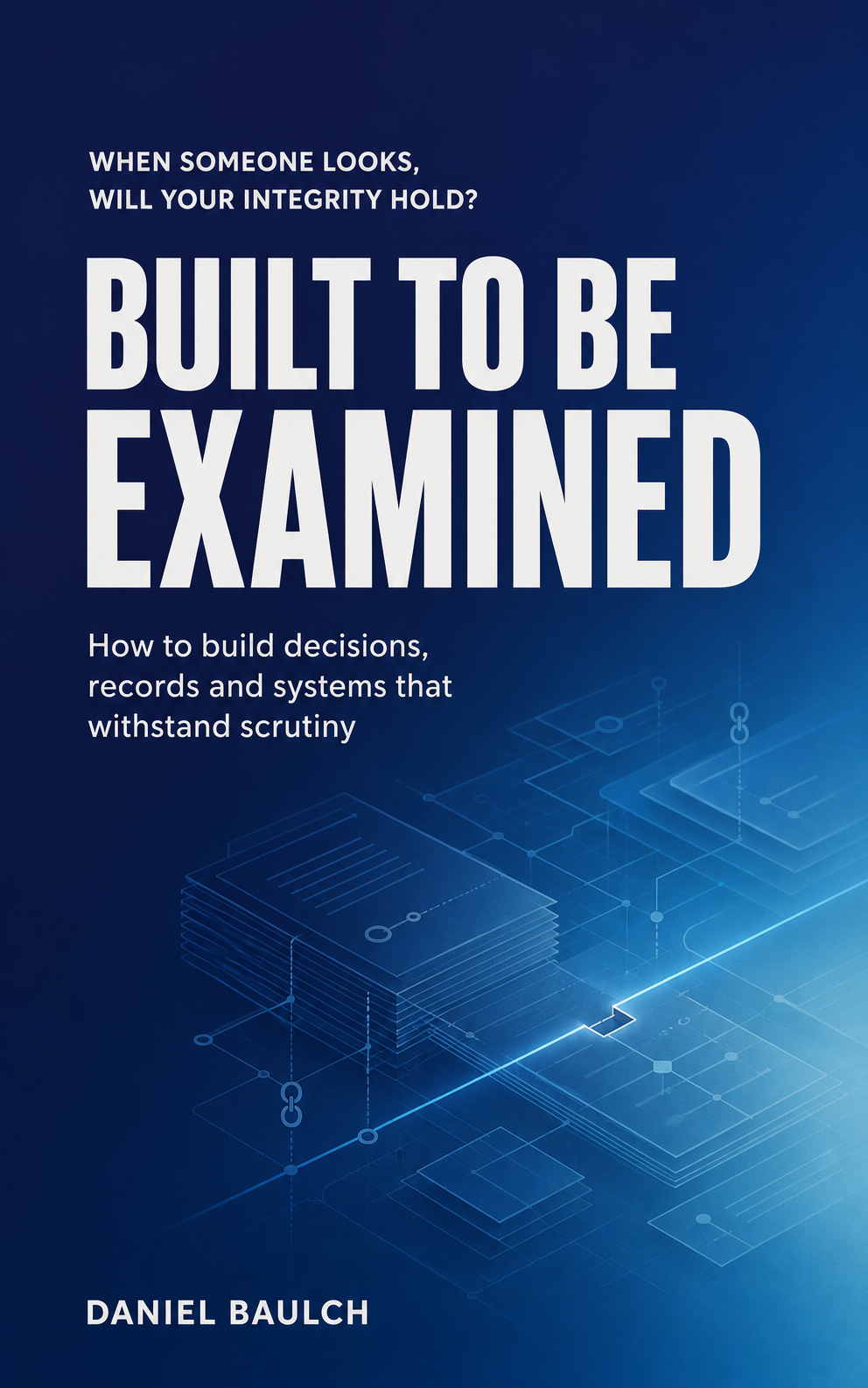
Built to Be Examined: How to build decisions, records and systems that withstand scrutiny connects the arrangements organisations need before something goes wrong with the discipline they need when it does.
For investigators, compliance practitioners, integrity officers and professionals developing their capability in this work.
The responsibility can arrive before the preparation.
A colleague raises a concern. A supplier relationship does not make sense. Someone hands you a collection of emails and says the evidence is obvious.
What would you question first?
Who can examine the matter impartially? What does the material actually establish? Has anyone considered another explanation? Could someone outside the organisation follow the reasoning?
These are questions worth understanding before you are expected to help answer them.
What you can take into your work
Recognise where independence breaks down.
Understand why reporting lines, relationships and personal stakes matter—and how independent oversight can help when the investigation itself must stay inside the organisation.
Look beyond the policy.
Examine how incentives, reporting channels, conflicts, procurement and recruitment shape the integrity arrangements people actually work within.
Understand why the first response matters.
Explore the sequence of preserving, examining, deciding and acting, and why sensible attempts to help can make a matter harder to establish.
Question the evidence behind a confident conclusion.
Understand the importance of original records, provenance and handling—and the limits of screenshots, copied files and confident AI-generated analysis.
Recognise what makes a process fair.
Explore why a genuine opportunity to respond, a willingness to reconsider and a record of reasoning belong at the centre of an investigation.
Think beyond the finding.
Consider referral decisions, recovery, the people affected and the work of rebuilding trust after the investigation ends.
Sixteen chapters. The whole organisational journey.
Part I — The exposure
Independence, the cost of misconduct and the gap between criminal conduct and improper conduct.
- No one impartial
- What it costs, and how long you have
- Not criminal, still improper
Part II — Building it before you need it
Culture, reporting, conflicts, procurement, recruitment and directors' responsibilities.
- Tone, code and what people actually believe
- Nobody was listening
- Conflicts, procurement and the third parties you inherit
- The trusted person was hired by you
- What directors actually owe
Part III — When something surfaces
The first 48 hours, testing certainty, evidence handling, fair process and decisions about involving police or lawyers.
- The first 48 hours
- Certain, and wrong
- Preserve, examine, decide, act
- A process built to be examined
- Police, lawyers, or neither
Part IV — After
Recovery, the aftermath and the wider weaknesses in how fraud is addressed.
- Getting it back
- The aftermath nobody plans for
- What we get wrong
The book draws on public inquiries and cases, alongside the author's experience across policing, professional standards, regulation and anti-corruption. Details of matters drawn from his own work have been adjusted to protect confidentiality.
For people who want to contribute more
Developing your knowledge?
Build a clearer picture of how integrity arrangements, investigative decisions and organisational accountability connect.
Already working in the field?
Test your assumptions against the book's treatment of independence, certainty, evidence and fairness.
Helping strengthen your organisation?
Use the questions raised throughout the book to examine reporting routes, oversight, controls and the way decisions are recorded.
“Take what is in it, test it against what you know, make it better, and pass it on.”
— Daniel Baulch, Built to Be Examined

Daniel Baulch
Daniel Baulch has spent more than twenty-five years establishing what happened inside organisations and what they did about it. His career includes work as a Victoria Police detective, years in Professional Standards Command, and three years as the inaugural Deputy Commissioner of Papua New Guinea's Independent Commission Against Corruption, where he built and ran its operations.
He now leads Integrity Solve. This book brings that experience to the question of what organisations can build before they discover they need it.
Questions about the book
Do I need to be an investigator?
No. You do not need a specialist role or investigative experience to find value in this book. Whether you are an employee, student, manager, business owner, volunteer, or simply curious about how organisations behave, it offers a way to think more clearly about trust, evidence, fairness and accountability. It can help you ask better questions and understand what a credible response to a concern looks like.
Will this qualify me to conduct investigations?
The book can help you develop your knowledge and judgement, whether you want to explore a new field, contribute more at work, lead a team or understand how decisions should be examined. It introduces ideas you can reflect on and discuss in your own setting. It does not award a qualification or replace the specialist training and experience needed to conduct investigations professionally.
Is it relevant outside Australia?
Yes. Questions about trust, conflicting interests, evidence and fair treatment arise in organisations everywhere. The book draws primarily on Australian legal examples, but its broader lessons can help readers in businesses, public institutions, community groups and other organisations think about their own practices. Specific legal requirements differ, so check the rules that apply where you are.
Where can I buy it?
You can explore the paperback and Kindle options through the Amazon Australia links on this page, or use the Amazon US link if that suits you better. Each listing shows the current price and availability. If you would like to get a feel for the book first, the complete opening chapter is free to read here — just add your first name and email to open it.
Related resources and services
Bring better questions to your next difficult matter.
Invest in your understanding of the decisions, records and systems that sit behind credible integrity work.
Read the opening chapterFree — add your first name and email to open it.